
Security and TSA PreCheck at Atlanta Airport (ATL)
Estimated Wait Time
Quick Questions
- 🛫 What is TSA PreCheck? A TSA program that allows you to go through a faster security lane: no need to remove shoes, belt, or light jacket, no need to take laptops out of bags or separate liquids. Costs up to USD 85 for 5 years, depending on the provider you enroll with.
- 🌎 Is it useful if I'm a foreigner who rarely flies to the U.S.? You can still enroll, but if you fly more than once every several years, Global Entry (USD 120 for 5 years) is usually a better value: it includes TSA PreCheck and also speeds up passport control upon arrival, which is precisely the step most criticized at ATL for international-domestic connections.
- 🆚 Is it the same as CLEAR? No. CLEAR is a private company that only speeds up identity verification before the scanner, not the physical screening itself. It can be combined with TSA PreCheck, but does not replace it. At ATL, unlike other airports where it's limited to a single terminal, CLEAR has points in both the North and South sectors of the Domestic Terminal.
- 📍 Where do I enroll within ATL? For CLEAR, there are enrollment pods in the Domestic Terminal North and South, near the Main Security Checkpoint. For TSA PreCheck and Global Entry, enrollment requires completing the online application and scheduling an in-person appointment at an enrollment center — there is no official confirmation that this center is located within ATL itself, so it's best to resolve it before traveling.
- 🤳 What is Mobile Passport Control (MPC)? A free CBP app that allows you to load your information and a photo before landing to access a faster lane at passport control. Available for U.S. citizens, permanent residents, Canadian B1/B2 visa holders, and Visa Waiver Program (ESTA) travelers who have visited the country before.
- 👁️ Does ATL have Touchless ID? Yes. Delta has deployed it at the main checkpoint of the Domestic Terminal South, both for security control and for baggage drop-off, with direct confirmation from Delta.com. There are press reports mentioning American and Southwest as part of the national Touchless ID program, but without direct official confirmation that they operate this technology specifically at ATL.
Image
AI-generated image
Critical Points to Keep in Mind
Load your Known Traveler Number (KTN) on every reservation
If the KTN is missing from your booking, you won't see the PreCheck indicator on your boarding pass and you'll go through the standard lane even if you're enrolled. Always check this before traveling, not just the first time.
Peak hours multiply wait times, with or without PreCheck
User experience:
The most congested hours at ATL checkpoints are from 5 to 9 in the morning and 4 to 8 in the afternoon. Long waits are one of the most repeated complaints across the entire airport, and the lack of staff in lanes that should be open is recurrently mentioned during peak hours.
Strategy: if you can choose your flight time, avoiding those two windows significantly reduces the risk of long lines. If you can't avoid them, add extra margin to your arrival time.
Not all checkpoints offer the same services
The identified checkpoints at ATL are concentrated in the Domestic Terminal: the Main Security Checkpoint, the Lower North Checkpoint (North Security), and the LNS access to all gates (Lower North Security). There is no official confirmation of a separate checkpoint exclusive to the Domestic Terminal South, nor of a distinct checkpoint in each concourse — it's best to check the signage or the MyTSA app upon arrival rather than assuming which entrance to use.
None of the three programs speeds up immigration if you don't have Global Entry
TSA PreCheck and CLEAR handle outbound security screening. If you're flying internationally and connecting to a domestic flight at ATL, the only program that speeds up passport control (CBP) is Global Entry — the rest of the international-domestic connection process is explained in the U.S. Customs, Immigration and Connecting Flights guide.
Staff treatment during peak times is the most repeated complaint
User experience:
This is one of the most critical points across the entire airport, with particularly harsh language in reviews: inconsistent demands from one moment to the next, and specific reports of treatment perceived as discriminatory or humiliating. Staff can completely transform the experience, for better or worse, with no clear pattern beyond passenger volume at the time.
Strategy: having your documents ready and a patient attitude helps the process move faster, even if the delay itself is beyond your control. If the treatment seems inappropriate, you can report it through the airport's official app.
Pros and Cons
Pros: CLEAR available at two points in the Domestic Terminal (North and South), broader than in other major U.S. airports; Delta's Touchless ID deployed both in security and baggage drop; TSA PreCheck significantly reduces wait times when the right lane is open; Global Entry solves the real bottleneck of international-domestic connections.
Cons: long lines and staff shortages during peak hours (5-9am and 4-8pm), one of the most repeated complaints at the airport; staff treatment highly inconsistent, with specific reports of perceived discrimination; no official confirmation of a dedicated checkpoint in the South Terminal or by concourse; exact location of TSA PreCheck and Global Entry in-person enrollment within ATL, unconfirmed.
TSA PreCheck, Global Entry, and CLEAR: Real Differences
The three programs are often confused because they all "speed up" the airport experience, but each solves a different problem:
TSA PreCheck (up to USD 85 for 5 years): speeds up physical security screening. With this benefit, you don't need to remove shoes, belt, or light jacket, nor separate laptops or liquids. Enrollment requires a 10-minute in-person appointment for fingerprinting, with approval in 3 to 5 business days.
Global Entry (USD 120 for 5 years): automatically includes TSA PreCheck, and also speeds up entry to the United States when arriving from an international flight, using an automated kiosk in the immigration area instead of the traditional line. Requires an in-person interview at an enrollment center — at ATL, the application is made by selecting the "ATL/FO/DOA" location; blitz enrollment events are also held periodically.
CLEAR: is a private, non-governmental service. It does not replace the other two — it specifically speeds up identity and boarding pass verification before reaching physical screening. It can be combined with PreCheck, but by itself it does not grant access to the PreCheck lane. At ATL, CLEAR has a presence at several points in the Domestic Terminal: CLEAR Standard in the Lower North sector, CLEAR with PreCheck in the South sector, and enrollment pods in both North and South near the Main Security Checkpoint.
Strategy: if you fly to the U.S. more than once every several years and you're a foreigner, Global Entry usually offers better value than PreCheck alone: for about USD 35-40 more, you add expedited immigration processing, which on an international-domestic connection at ATL is usually the biggest bottleneck, not outbound security.
How Security Screening Works at ATL
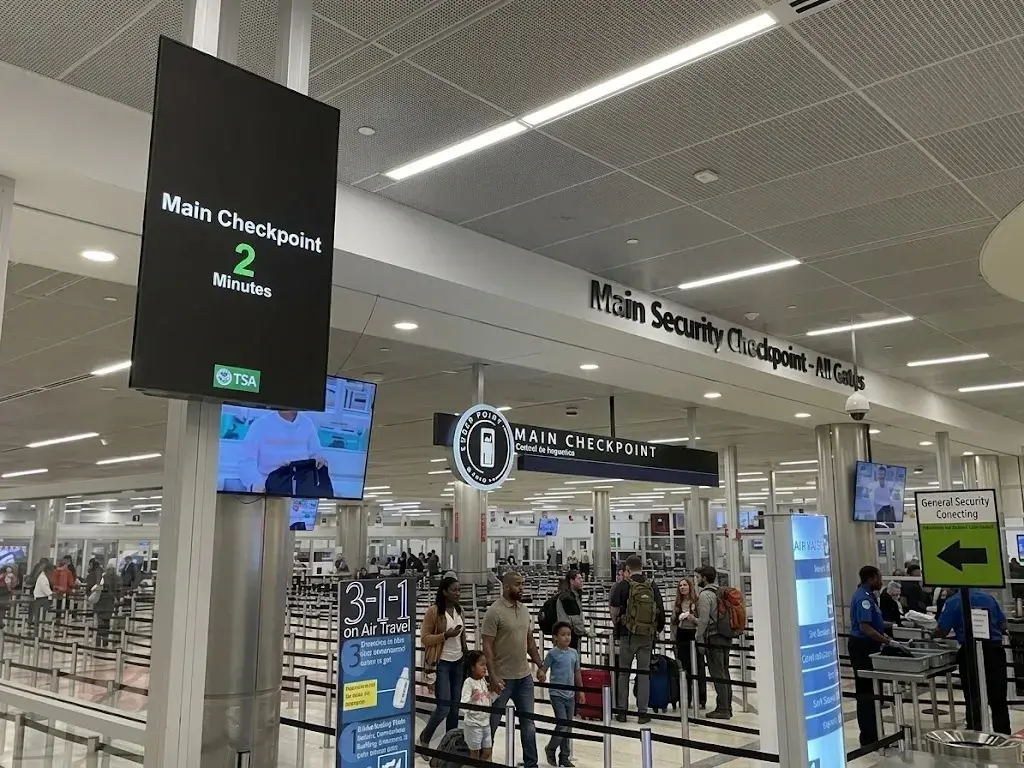
The identified security checkpoints at ATL are concentrated in the Domestic Terminal: the Main Security Checkpoint, the Lower North Checkpoint (North Security), and the Lower North Security access to all gates. There is no official information available confirming a dedicated checkpoint for the Domestic Terminal South, nor a complete list of checkpoints by concourse — if your gate is far from the main checkpoint, it's best to confirm the most convenient location in the MyTSA app or airport monitors before choosing which entrance to use.
User experience:
Security line waits are the most repeated complaint at ATL, regardless of concourse or time. Several travelers report having arrived with enough time and still having had to run to their gate. Staff shortages in lanes that should be open are a recurring problem, especially between 5 and 9 in the morning and 4 and 8 in the afternoon.
Strategy: enrolling in TSA PreCheck or CLEAR is the decision that has the most impact on the security experience at ATL. If you don't have either, add at least 30 extra minutes to your usual margin during peak hours, and arrive at least 2.5 hours early for domestic flights and 3-4 hours for international ones.
Staff Treatment at Checkpoints
User experience:
This is one of the most critical points across the entire airport according to the reviews processed, with particularly harsh language from travelers. Complaints include demands that vary from one moment to the next and, in some cases, treatment perceived as discriminatory or humiliating. At the same time, in special assistance, information, and other contact points, there are specific mentions of friendly and professional staff — the dominant pattern is inconsistency, not uniformly bad experience.
Strategy: having your documents ready and a patient attitude helps the process move faster, even if the delay itself is beyond your control. If the treatment seems inappropriate, you can report it through the airport's official app.
Touchless ID at ATL
Delta has deployed TSA PreCheck Touchless ID at the main checkpoint of the Domestic Terminal South: a system that verifies your identity by facial recognition in dedicated lanes, without needing to physically show a passport or boarding pass. It is also available at Delta's baggage drop areas, with distinctive "Touchless" signage — you can check your luggage by looking at the camera, without showing your ID. It is available only for TSA PreCheck or Global Entry members who choose to participate through the Delta app, loading their Known Traveler Number and passport data in advance.
There are press reports mentioning American Airlines and Southwest as part of the Touchless ID program nationally, but without direct official confirmation that they operate this technology specifically at ATL checkpoints — if you're flying with either of those, it's best to confirm with the airline before counting on this benefit.
Important: although the system does not require showing physical ID, it is still mandatory to carry it as backup in case an officer specifically requests it.
How to Enroll, and Where to Do It Within ATL
TSA PreCheck enrollment is done online at tsa.gov/precheck, choosing from authorized providers (CLEAR, IDEMIA, or Telos), followed by a brief in-person appointment for fingerprinting and document verification. For Global Entry, the application is also done online through the Trusted Traveler Programs system, selecting "ATL/FO/DOA" as the location; after conditional approval, you must complete an in-person interview, either at an enrollment center or at one of the periodic blitz enrollment events.
For CLEAR, ATL has its own enrollment pods inside the airport, in the Domestic Terminal North and South, near the Main Security Checkpoint — unlike TSA PreCheck and Global Entry, for CLEAR you don't need to leave the airport or schedule an appointment in most cases.
Several travel credit cards fully or partially reimburse the enrollment cost for one of these programs — it's worth checking your card's benefits before paying out of pocket.
Strategy: once approved, load your Known Traveler Number (KTN) on every flight reservation and verify that the PreCheck indicator appears on your boarding pass before arriving at the airport.
Mobile Passport Control (MPC): The Free Alternative
If you don't have Global Entry, the free CBP app Mobile Passport Control (MPC) is an alternative available at ATL to speed up passport control upon arriving from an international flight. It is available for U.S. citizens, legal permanent residents, Canadian B1/B2 visa holders, and Visa Waiver Program (ESTA) travelers who have visited the country before. It allows you to load your data and a photo before landing to access a faster lane — it doesn't replace Global Entry in speed, but it's free and requires no prior enrollment.
