
Passengers with Reduced Mobility and Special Needs at ATL
Guide to the Reality of Assistance Services at Atlanta Airport
Atlanta Airport offers a wide range of services for passengers requiring assistance. However, traveler experiences reveal a significant gap between the services offered and the actual assistance received. This guide combines official information with hundreds of reviews to prepare you and help you navigate the challenges of traveling through ATL with special needs.
Quick Questions about Assistance at ATL
- ♿ How is the wheelchair service? It is the most criticized service at the airport. Travelers report serious and constant failures: assistance often doesn't arrive, is delayed for hours, or staff refuses to help. Extreme proactivity is essential.
- 🛂 Is there assistance at security checkpoints (TSA)? The experience is very inconsistent. Special access lines are not always clearly marked and TSA staff are often described as unhelpful. Call TSA Cares at +1 855 787 2227 at least 72 hours before your flight to coordinate advance assistance.
- 🧠 Is there support for passengers with autism? Yes, and it's one of the most positive points. The multisensory room in Concourse F is highly praised by families. Key tip: get the access code before going through security, at any Delta check-in counter in the Domestic Terminal.
- 🐾 What about service animals? The indoor relief areas in each concourse and the outdoor park are considered excellent, clean, and well-maintained. Indoor locations are at gates T7, A10, B33, C17, E15, F7, and D Centerpoint.
- 💡 What is the most important tip? Be your own advocate. Confirm, re-confirm, and confirm again any assistance request directly with your airline and be insistent upon arriving at the airport. Don't assume help will be ready.
- 🌻 What is the Hidden Disabilities Sunflower program? A sunflower lanyard you can wear to discreetly indicate that you have a non-visible disability (autism, anxiety, PTSD, hearing loss, etc.) and may need more time or assistance. It does not require medical documentation. Request it at any airport information counter.
Critical Points: Smart Traveler's Manual
Wheelchairs: the service with the most failures at the airport
User experience:
Reviews of the wheelchair service at ATL are consistently the harshest of the entire airport. The most repeated patterns: assistance requested in advance simply doesn't show up, waits exceed two hours in some cases, and assigned staff sometimes refuse to push the wheelchair or leave the passenger alone without notice. The problem is not infrastructure but coordination and attitude.
Strategy: Apply multiple confirmation: call the airline several days in advance, again 24 hours before, and upon arriving at the check-in counter, don't move until you have certainty that an assistant is on the way. For nighttime assistance between 9pm and 5am, contact the operating companies directly: Prime Flight (Air Canada, Alaska, American, Contour, Spirit, and Turkish) at 404-530-7049; Prospect (JetBlue, Southwest, and United) at 404-209-0503.
TSA: how to reduce friction at security
User experience:
Special access lines at ATL TSA checkpoints are not always clearly marked, and staff can be inconsistent in their treatment of passengers with medical conditions or special devices. Those who plan ahead through TSA Cares report a significantly less stressful experience.
Strategy: Call TSA Cares (+1 855 787 2227) at least 72 hours before your flight to coordinate assistance at the security checkpoint. The service does not guarantee priority processing, but it allows staff to be prepared for your specific needs. If you use the airline's wheelchair service, the assistant will accompany you through security.
Non-visible disabilities: the Sunflower program
User experience:
ATL participates in the Hidden Disabilities Sunflower program, which allows travelers with non-visible conditions (autism, anxiety, PTSD, chronic pain, hearing loss, chronic fatigue) to discreetly signal that they may need more time or support. Several travelers report that the lanyard generates a more empathetic response from staff at checkpoints and counters.
Strategy: Request the sunflower lanyard at any airport information counter. It does not require medical documentation or explanation. It is especially useful at TSA checkpoints and airline counters where wait times can generate anxiety.
Wheelchair Assistance: The Biggest Challenge
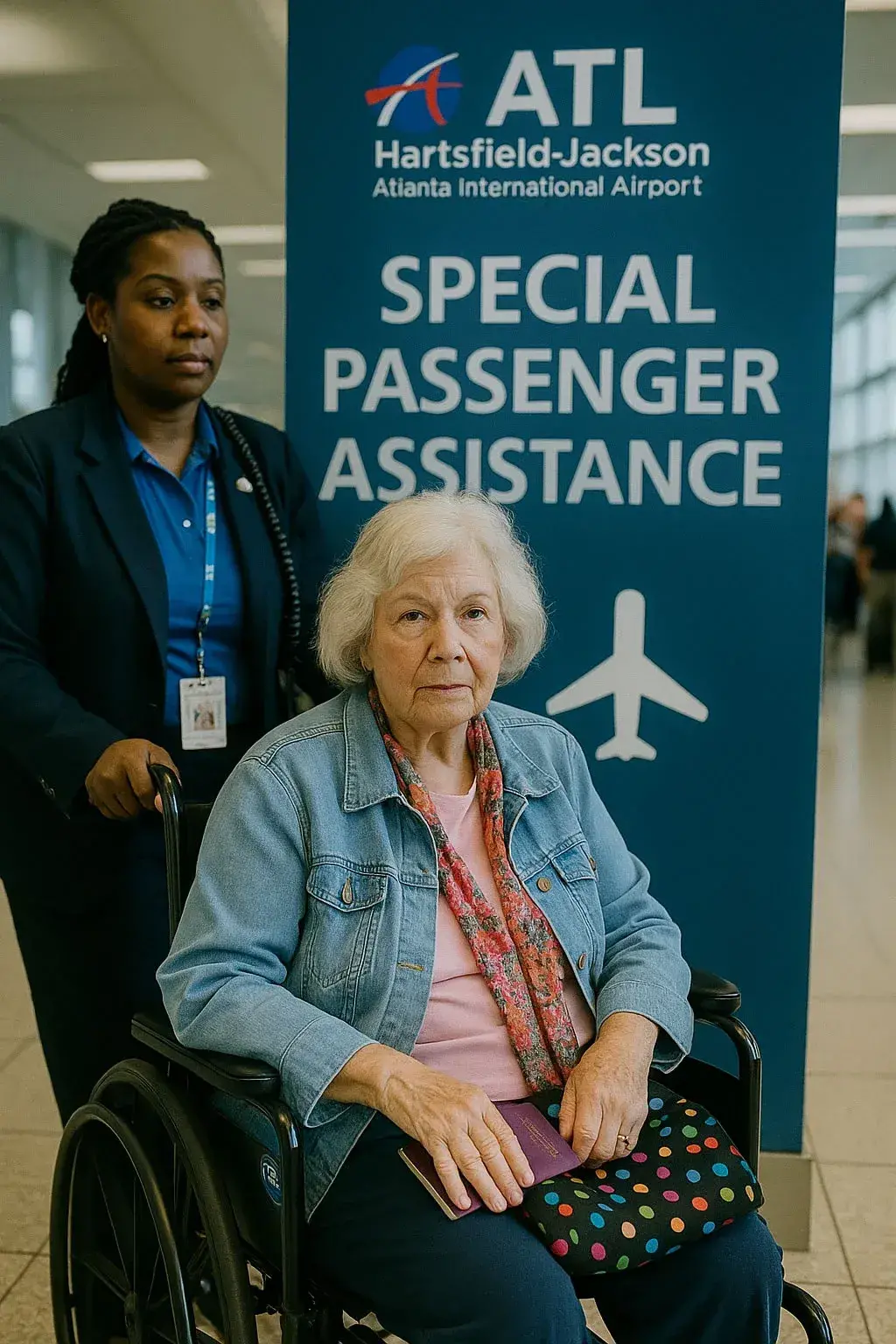
Officially, wheelchair assistance must be requested directly from your airline at least 48 hours in advance.
Image
AI-generated image
Real user experience: This is, unfortunately, the service with the worst reviews in the entire airport. Travelers consistently report serious failures: requested assistance never arrives, waits exceed two hours, or assigned staff are rude and refuse to push the wheelchair, leaving passengers alone. To avoid a traumatic experience, a multiple confirmation strategy is recommended: call the airline days in advance, again 24 hours before, and upon arriving at the check-in counter, don't move until you have certainty that an assistant is on the way.
TSA Cares Assistance: Plan Ahead
TSA Cares is a helpline to plan your passage through security. You can call +1 855 787 2227 at least 72 hours before your trip to clarify questions about screening policies for disabilities or medical conditions.
User experience: Those who use this planning service find it useful for reducing anxiety. However, it is not an on-the-spot solution. At the airport, the reality is that special access lines are not always clear and TSA staff can be inconsistent in their treatment.
Passengers with Autism: A Calm Space
In collaboration with The Arc, Delta Air Lines offers a multisensory room in Concourse F (boarding level). This space is designed to be a calm refuge, with a ball pit, tactile panels, and other elements to help prepare travelers on the autism spectrum.
Practical tip: Get the access code before going through security, at any Delta check-in counter in the Domestic Terminal. This avoids having to look for it in Concourse F when you may already be stressed. You can also request it at the Concourse F departures information counter.
User experience: This initiative is one of the highest rated at the airport. Families describe it as an essential resource that makes a positive and significant difference in their travel experience.
Hidden Disabilities Sunflower Program
ATL participates in the international Hidden Disabilities Sunflower program, designed for travelers with non-visible disabilities: autism, anxiety, PTSD, chronic pain, hearing loss, chronic fatigue, and other conditions that are not obvious at first glance.
Wearing the sunflower lanyard is a discreet way to indicate to airport staff that you may need more time, patience, or additional assistance, without having to explain your condition in every interaction. It does not require medical documentation. Request it at any airport information counter.
User experience: Several travelers report that the lanyard generates a more empathetic response from staff, especially at TSA checkpoints and airline counters.
Accessible Transportation and Parking
- Ground Transportation: Shared-ride shuttles and hotel shuttles usually have accessible options, but wait times can be long during peak hours. Signage to find taxi and app pickup points can be challenging. ADA-compliant taxis with ramps are available, though the fleet is very small — it's recommended to book hours in advance. Uber (WAV) and Lyft (Access) have accessible vehicle options, though availability varies.
- MARTA: The infrastructure has elevator access. The airport station is undergoing renovation with new elevators, digital signage, and platform improvements, with completion expected by June 2026. For information on accessible services: 404-848-4711.
- Accessible Park-Ride Parking: Offers free accessible shuttle from your vehicle to curbside check-in. Rate: $3 per hour / $10 per day. 24-hour contact: 404-530-6725. Lots fill up quickly during peak season — book in advance.
Additional Well-Rated Services
- Accessible Restrooms: All airport restrooms are wheelchair accessible and there are unisex family restrooms in all concourses. Adult changing table available in the Concourse F family restroom (departures level, near French Meadow Cafe).
- Service Animal Relief Areas: Indoor locations at gates T7, A10, B33, C17, E15, F7 and D Centerpoint. 1,000 sq ft outdoor park at Ground Transportation, Domestic Terminal South, gates W1 and W2 — with biodegradable bags and benches. Well-rated for cleanliness and convenience according to reviews.
- TTY/TDD Telephones: Available at the airport, though users suggest they could be better signed. Check the official accessibility map at atl.com/ADA for exact locations.
- Electric Wheelchair Charging Stations: Available at the airport so users of electric mobility devices can recharge during their stay.
Pros and cons of services for special passengers at ATL
Pros: multisensory room in Concourse F for travelers on the autism spectrum, highly rated; Hidden Disabilities Sunflower program available without medical documentation; service animal relief areas in all concourses, clean and well-maintained; accessible restrooms and unisex family restrooms throughout the airport; TSA Cares for advance coordination of security assistance; Park-Ride with accessible shuttle at $10/day; ongoing MARTA station renovation with accessibility improvements.
Cons: wheelchair service with the worst review history at the airport — frequent failures, long waits, and inconsistent staff attitude; TSA without clearly marked special access lines at all points; poor signage for accessible transportation in the arrivals area; extremely limited ADA-compliant taxi fleet; Park-Ride and accessible parking that fills up quickly during peak season; TTY/TDD telephones with signage that could be improved.
