
U.S. Customs, Immigration and Connecting Flights
See which concourse your airline uses in our ATL airline directory and how TSA PreCheck speeds up security screening.
Quick Questions about Immigration and Connections
- 🔄 Can I make an international connection without going through the whole process again? No. If you arrive on an international flight at ATL, you must go through immigration (CBP), collect your checked luggage, clear customs, and re-check it before your next flight — whether domestic or also international. ATL does not have a sterile corridor for international-international connections.
- 🛬 What if my connection is 100% domestic? Unlike other airports with separate terminals, all domestic concourses at ATL (T, A, B, C, D, and E) are within the same secure area, connected by the Plane Train. If your connection is domestic from end to end, you do not need to go through security control again to change concourses.
- 🚆 How do I move between concourses if I need to change? Using the Plane Train, free and available 24 hours, with trains approximately every 2 minutes (reduced service between 1am and 5am). If your connection arrives from an international flight, after re-checking your luggage you take the Plane Train from the underground Level 0 station in Concourse F.
- 🎫 I bought the legs separately, does that change anything? Yes. If your two flights are not on a single reservation, you may have to complete the full arrival process and check in again with the second airline, as if it were a different trip — without the protection of automatic rebooking if your first flight is delayed.
- ⏱️ What minimum connection time should I leave? It depends on the connection type. For a 100% domestic connection, the suggested minimum is 75 minutes, with 90 minutes as a more comfortable margin. For an international to domestic connection, the suggested minimum rises to 150 minutes, with 3 hours (180 minutes) as the recommended stress-free margin.
Image
AI-generated image
Critical Points: Smart Traveler's Manual
Collect your luggage even if it's tagged to your final destination
User experience:
If you arrive on an international flight, you must collect your checked bags at baggage claim and re-deliver them before your next flight. Several travelers mention having mistakenly assumed that luggage transfers automatically — even when flying with the same airline.
Strategy: Assume that you will have to collect and re-check your luggage on any connection that starts with an international flight, and factor that time into your margin.
Don't confuse the external shuttle with the Plane Train
User experience:
Several connecting travelers report having mistakenly followed the external shuttle, thinking it was the way to their next gate, losing valuable time. The shuttle connects to the public area of the Domestic Terminal (to take MARTA or be picked up); it is not the route for a connection.
Strategy: If you're on a connection, after re-checking your luggage, follow the signs to the Plane Train, not to the general exit or the shuttle.
Security control repeats, even with luggage already checked
User experience:
Several travelers do not anticipate that after re-checking luggage at the International Terminal, you must go through security control (TSA) again before reaching the next gate.
Strategy: Add the TSA step to your time calculation, unless your specific flight qualifies for the pilot program for remote luggage re-check (One-Stop Security with Global Entry/Mobile Passport Control), available only on select routes.
If you need reduced mobility assistance, coordinate it in advance
User experience:
Wheelchair service is one of the most criticized at the airport, with reports of long waits or assistance that never arrives, and this immigration stretch is no exception.
Strategy: Confirm the request with your airline several times (days before, 24 hours before, and upon arriving at the counter). TSA Cares (1-855-787-2227) helps plan security screening with at least 72 hours' notice.
Pros and cons of immigration and connections at ATL
Pros: Free and frequent Plane Train connecting all domestic concourses within the same secure area, without needing to go through security again on a 100% domestic connection; Global Entry speeds up the longest step with automated kiosks; automatic rebooking at no cost when delays occur within the same reservation.
Cons: no sterile international corridor, even if the next flight is also international; immigration times vary greatly depending on how many international flights arrive simultaneously; separate tickets with no rebooking protection if the first leg is delayed.
How connections work at ATL by flight type
The process depends on the type of arrival and departure flight. Knowing it in advance avoids surprises and helps calculate the available time:
Domestic → domestic: you stay in the same secure area throughout the connection. The Plane Train connects all domestic concourses without needing to go through security again, even if you change concourses.
International → domestic or international: you must go through immigration (CBP), collect your luggage, clear customs, re-check it, and go through security control (TSA) again before heading to your next gate. This applies even if your next flight is also international — ATL does not have a sterile corridor for this case.
With separate tickets: if your two legs are not connected in a single reservation, you may need to complete the full arrival process and check in again with the second airline.
User experience:
The transition between international and domestic flights is one of the airport's most criticized points, with consistent reports of slow wait times in the baggage collection and re-check process. Staff treatment in this stretch is very inconsistent: it can be excellent or directly rude depending on the shift and timing, with no clear pattern beyond passenger volume. Those using TSA PreCheck or Global Entry consistently report a much faster experience than the traditional line, even during the busiest times.
Strategy: if your connection includes an international leg and you have little margin, prioritize carry-on luggage over checked luggage whenever possible, and notify an airline agent as soon as you land if you see time is tight.
Moving between concourses during a connection
All connections within ATL's secure area — domestic, and after completing the immigration process, also international — are handled by the Plane Train, which connects all seven concourses (T, A, B, C, D, E, and F) in under 15 minutes from end to end. It operates 24 hours, with trains approximately every 2 minutes, although between 1am and 5am it runs in reduced mode (lower frequency).
If you prefer to walk, there is a parallel pedestrian tunnel with moving walkways connecting the domestic concourses, with a light and sound installation between Concourses A and B that makes the journey more pleasant.
Important: the external shuttle is a different service, only for those leaving the secure area to the public Domestic Terminal (for example, to take MARTA or be picked up) — it is not the option for a connection.
Immigration and customs (CBP) upon arrival at ATL
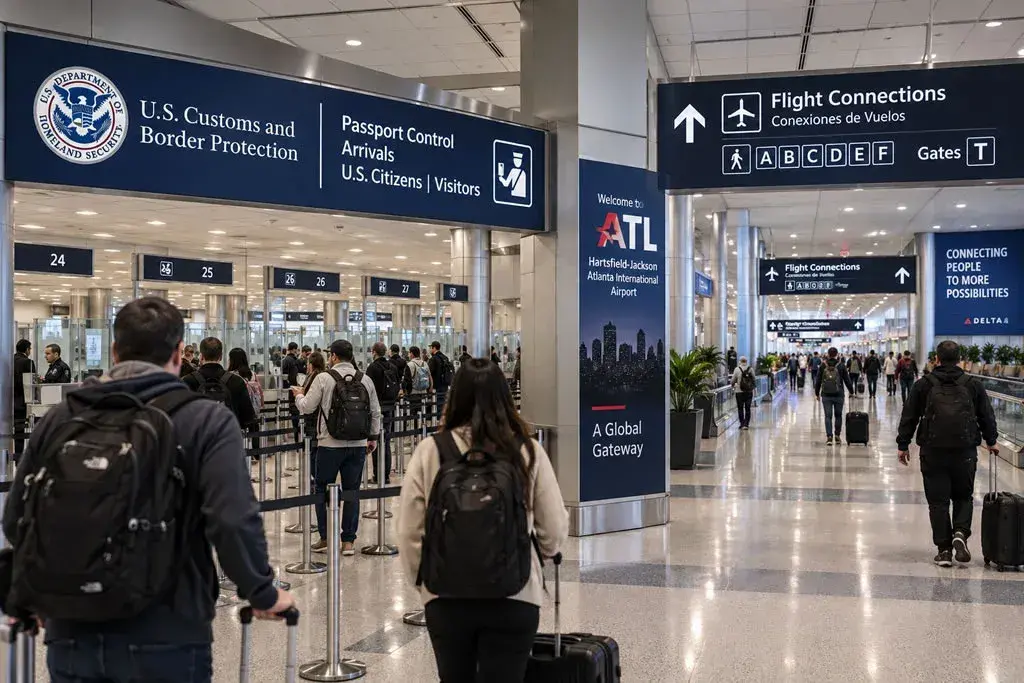
Passengers arriving on an international flight first go through CBP passport control in Concourse F, then collect their luggage and clear customs. Those with Global Entry can use automated kiosks instead of the traditional line. Afterwards, those on a connection re-check their luggage and go through security control (TSA) again before heading to their next gate.
User experience:
Security lines are the most repeated complaint at ATL regardless of concourse or time, and the immigration process is no exception: there are reports of short waits and very long waits, depending on how many international flights land simultaneously. TSA staff are frequently mentioned as inconsistent, with requirements that vary from moment to moment and, in some cases, treatment perceived as unsympathetic. Assistance to passengers with reduced mobility in this area is a repeated weak point, with long waits for a wheelchair or accompaniment.
Strategy: have your passport and travel documents accessible before getting off the plane, and if you need reduced mobility assistance, coordinate it with your airline in advance rather than requesting it only upon landing.
